| Updated: June 13, 2026 |
Published: 2010-08-10 |
(eNews.pk) -
LONDON: Carnivorous plants refer to any meat-eating plants with urn-, trumpet-, or pitcher-shaped leaves. Asclepiadaceae (milkweed family), Sarraceniaceae (new world pitcher plants, or Sarracenia genus found in the eastern part of North America), and Nepenthaceae (Old World pitcher plants) are some of their examples. They inhibit primarily in wet or sandy meadows, savannas, swamps, bogs, fens, or any places where the soils are acidic, water-saturated, lack of phosphates or nitrates, and sunshine seasonally abundant living environments.
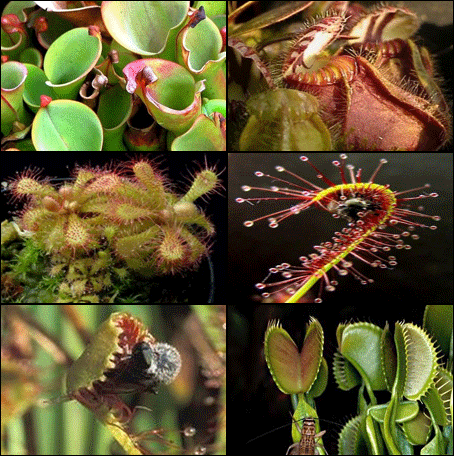
The known species of carnivorous plants are more than 660 species and 9 plant families, with the Venus flytrap being the famous and one of the most abundant species among them. Meanwhile, the Utricularia genus is identified as the largest number of the species on earth.
These plants do not appear as early as other prehistoric plants on earth. The reason is that they need Nitrogen as their essential nutrients for their growth. Most plants cannot absorb Nitrogen directly from the air, except for a small number of leguminous plants, which are adapted with unique nitrogen-fixing property as in the example of Rhizobium.
Most carnivorous plants inhibit in some water-saturated places, which are found to be more prone to lack of Nitrogen. In order to sustain the survival, most living things had by means to undergo certain evolution processes to enable themselves to be adapted with their own “fixing” property or to survive in low-nutrients environments.
That means, they have to break down the insects to obtain their Nitrogen content (insect bodies contain about 10.5% nitrogen), and hence they are termed as meat-eating plants. The nitrogen content in their tissues that is obtained from their prey ranges from 20 to 75%, depending on their species (such as Cephalotus, Drosera, Nepenthes, Pinguicula, Sarracenia, Utricularia, and etc.).
Apart from Nitrogen, Utricularia and Triphyophyllum are also known to absorb Magnesium and Potassium, while Sarracenia absorbs Phosphorus in prey. The adaptation of their leaves specially modified as traps enable them to obtain some nutrients by trapping and digesting various invertebrates, and occasionally they may even digest larger animals such as frogs and mammals.
Most carnivorous plants can carry out photosynthesis (a process which enables plants to make their own foods), besides digesting their prey to obtain essential nutrients. Meanwhile, they can sustain under extreme environmental surroundings. They are adapted with a prey-trapping mechanism feature characterizing by their deep cavity filled with liquid known as a pitfall trap.
Scientists believe that they may have evolved from rolled leaves, with selection pressure favoring more deeply cupped leaves over relatively long evolutionary time. Some of them such as Nepenthes are placed within clades consisting particularly of flypaper traps, but some have evolved from flypaper traps by loss of mucilage. Very often, these plants climb by tendrils. The end of these tendrils may develop into pitchers, which help them to capture and digest insects.
In insectivorous plants (insects are one of their common prey items), their leaves appear in the form of deep cups or pitchers in which visiting insects will fall into them. Once in the plant, the prey tumbles down into a liquid pool and drowns, and then they are digested by the action of enzymes secreted by cells located in the walls in their pitcher-like structures of these plants.
The digestion of prey releases nitrates and other nutrients, and these essential nutrients are then absorbed for their growth. The Venus flytrap, which has leaf lobes, is one of the wonder in the world of plants as this carnivorous plant can capture its prey very quickly in a terrifying way. The Utricularia genus is an underwater plant, which can suck its prey into bladders with its fastest-acting trap in times as short as 1/30 of a second. Meanwhile, the complex-acting trap belongs to genus Genlisea.
|
|



Enews.pk